NMC Ethical Advertising Guidelines 2026: What Actually Changes for Healthcare Businesses
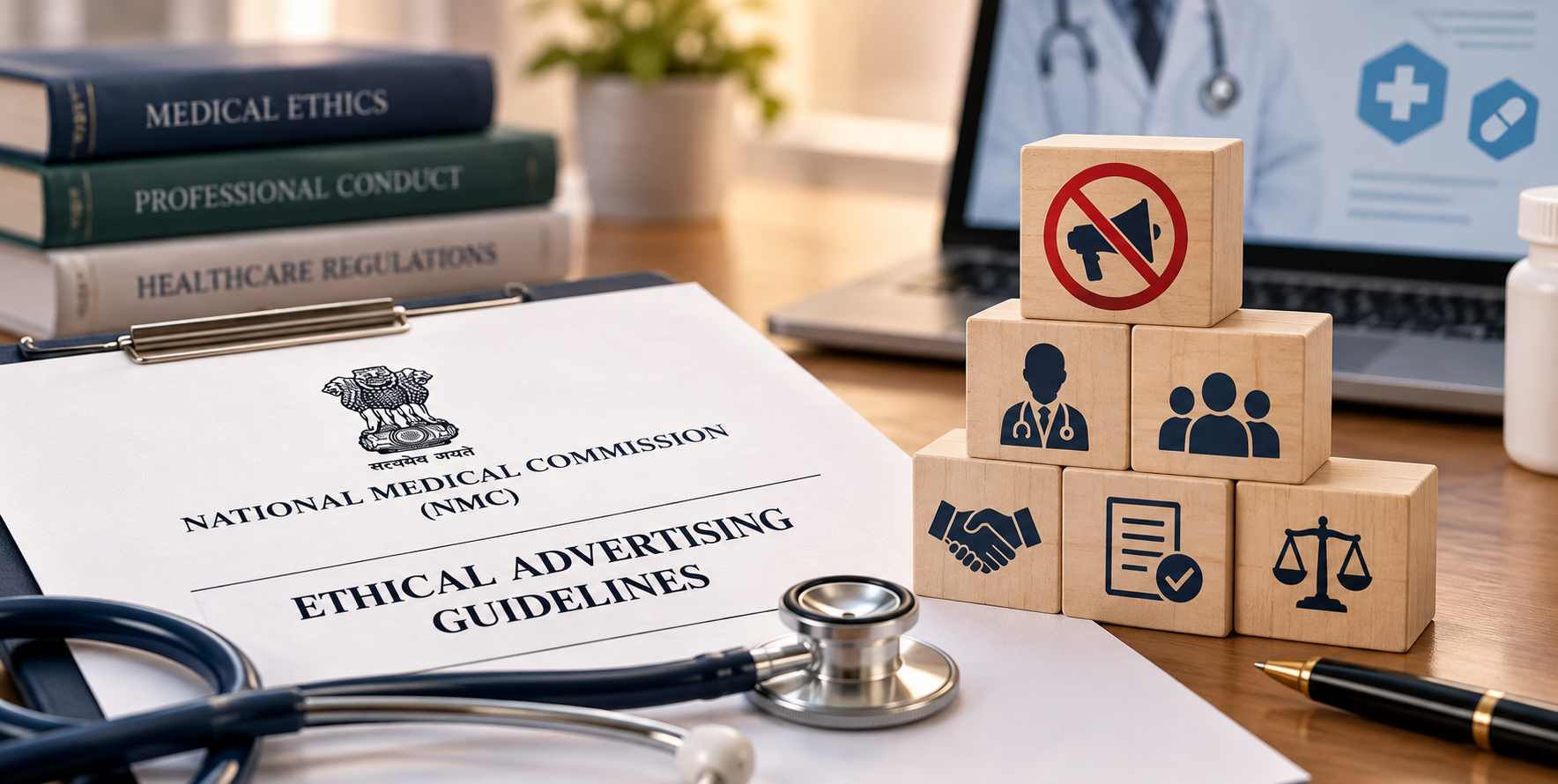
On 6 October 2026, the National Medical Commission ("NMC"), the national regulator of the medical profession in India, issued the Guidelines on Ethical Advertising and Public Communication by Hospitals/Medical Institutions and Registered Medical Practitioners (the "Guidelines"). They came into force immediately, and they now shape how doctors, hospitals, diagnostic laboratories and healthcare platforms in India may advertise and communicate with the public. This article explains what the Guidelines say, who they apply to, and the gaps they still leave open.
1. Background: Medical Advertising Rules in India Before 2026
A Registered Medical Practitioner ("RMP") is a doctor whose name appears in the National Medical Register or a State Medical Register. Until now, the advertising conduct of such doctors was governed by the Indian Medical Council (Professional Conduct, Etiquette and Ethics) Regulations, 2002. These Regulations remain in force because the NMC put its own 2023 conduct regulations on hold. The 2002 Regulations were issued long before social media, search engines and artificial intelligence ("AI") became common tools of promotion.
The Guidelines fill this gap. They state that digital, social media, sponsored, influencer-led, search-engine, platform-based and AI-generated communication will be treated as advertising where it promotes a doctor or a hospital. Information that is shared with the public without any promotional purpose or commercial benefit is excluded from this meaning.
2. What the NMC Advertising Guidelines Allow and Prohibit
What is allowed. Hospitals may share factual and verifiable information, such as their name, location, departments, equipment, emergency services, accreditation and charges. Doctors may announce the start of a practice, a change of address, a temporary absence or their fees. They may also give public health talks and share general health information, as long as they do not promote themselves.
What is not allowed. The Guidelines list what a doctor must not do. In plain terms, a doctor must not:
- seek patients directly or indirectly, or promote his or her own services;
- use words such as "Best doctors", "No.1 Specialist" or "100% success", or claim success rates;
- show before-and-after photographs or promote patient success stories;
- offer discounts, coupons, cashbacks or similar benefits that attract patients;
- pay or receive commission or referral fees for patients;
- use fake or paid reviews, fake followers, or manipulate search rankings to create a false impression of standing.
AI-generated promotion has its own rule. The Guidelines prohibit an AI-generated promotional campaign for commercial interest, and requires content that follows the Guidelines to carry a mark stating that it was created by AI. AI may not be used to create a patient's image, voice, testimonial or clinical result.
What happens on a breach. The State Medical Council may take graded action against a doctor. A first violation may lead to a warning and ethics training. A second may lead to censure and a monetary penalty. A third may lead to suspension of registration for three to six months. Serious violations may lead to suspension of six to twelve months, and repeated violations to removal from the register for one to three years. The doctor must first receive a show-cause notice and an opportunity to reply, and may appeal to the NMC within 60 days.
3. Key Nuances and Grey Areas in the NMC Guidelines
The Guidelines apply to doctors and hospitals, but others are affected. The Guidelines are addressed to doctors and hospitals. Yet the Guidelines say that a doctor cannot avoid responsibility by saying that an agency, influencer or online platform published the content, if the doctor authorised it or knowingly allowed it. The Guidelines also add that a doctor may not use a third party to do what the doctor cannot do directly. For this reason, agencies, marketing vendors and online platforms are affected even though the Guidelines do not penalise them directly.
The rule on AI has two sentences that point in different directions. The first sentence of the AI rule prohibits AI-generated promotional campaigns for commercial interest. The second sentence speaks of AI-generated promotional content that follows the Guidelines and must carry an AI mark. This suggests that some AI promotion may be allowed, however, there is no clarity about which AI generated content may be flagged as a violation.
Doctors may not hire third parties for marketing, but agencies are also mentioned. The Guidelines say that a doctor must not engage any third party for marketing medical services. Another provision deals with agencies, influencers and online platforms, and objects only to payment that is linked to bringing in or referring individual patients. The two provisions leave open whether an agency paid a fixed fee is permitted.
Online platforms are mentioned, but not defined. The Guidelines require healthcare platforms that host doctors to follow the NMC's advertising norms, not to rank doctors for payment, and to keep their listings transparent. The term "healthcare platform" is not defined, and the Guidelines do not state a penalty for platforms. A separate set of rules, the Telemedicine Practice Guidelines, 2020, allows a non-compliant telemedicine platform to be blacklisted.
Patient consent does not cure a prohibited practice. A patient's consent does not make a testimonial, a success story or a before-and-after picture permissible if the Guidelines otherwise forbid it.
"Best" and "top" are not banned outright. Comparative words such as "best", "leading" or "top" are allowed only if the claim can be objectively verified, rests on a transparent and independent method, and is otherwise lawful. Any ranking or award used in an advertisement must disclose its method, date and the body that gave it.
Search ranking is regulated only when it misleads. The Guidelines prohibit manipulating search rankings, visibility or algorithms to create a misleading impression of professional standing. The Guidelines do not mention ordinary search optimisation by name. The dividing line is whether the practice misleads.
Educational content has conditions. Health education is protected only if it does not promote the doctor's practice, does not seek patients and is not monetised through promotional marketing. Content that is paid for and also attracts patients may fall on the wrong side of this line.
4. Hospitals, Medical Institutions and Clinical Establishments: Where the Guidelines Meet State Law
Parts 1 to 3 dealt mainly with doctors, because the NMC's power runs directly over them. The Guidelines also speak of "Hospital/Medical Institution" and of "clinical establishments", which appear in several places without a separate definition. These terms lead outside the Guidelines, first to the NMC Act and then to State clinical establishment laws. Who is covered therefore depends on how the terms are read together, and this Part follows that chain.
What the NMC Act says. The National Medical Commission Act, 2019 ("NMC Act") defines "medical institution" as an institution within or outside India that grants degrees, diplomas or licences in medicine, and includes affiliated colleges and deemed universities. In simple terms, it means a medical college or university. It is a term about medical education.
What the Guidelines say. The Guidelines use the same words for a different thing. It describes a hospital or medical institution as a clinical establishment that provides facilities for the diagnosis, treatment or care of illness, where patients may be admitted or treated as out-patients, and it includes an institution covered by the Clinical Establishments (Registration and Regulation) Act, 2010 ("CE Act") or any other State Act. For the purposes of these Guidelines, therefore, the meaning given in the Guidelines applies, and the NMC Act meaning of "medical institution" does not. The mixed use of the term is a drafting inconsistency.
Diagnostic laboratories. The Guidelines do not mention laboratories. They speak of facilities for the diagnosis, treatment or care of illness where patients are admitted or treated as out-patients, and they refer to the part of the CE Act which, lists places such as hospitals, nursing homes and clinics.
Clinical establishment laws deal with laboratories separately and generally treat a stand-alone laboratory as a clinical establishment in its own right. On that reading, a stand-alone laboratory sits outside the wording of the Guidelines. An in-house laboratory is different. State clinical establishment laws provide that a laboratory forming part of a clinical establishment need not register separately. Since the law treats such a laboratory as part of the hospital, it can be argued that the Guidelines include such laboratories within its purview.
Industry impact. Hospital chains with in-house laboratories, stand-alone diagnostic providers, sellers of health check packages, and online platforms that book tests or consultations are the businesses most affected by these gaps. Each may be treated differently depending on how the terms are read and on the State in which it operates. A reliable reading for any one business needs a State-specific examination.
5. Benefits and Burdens for Healthcare Providers
Benefits. Patients receive more reliable and verifiable information. Hospitals and doctors receive a clear list of what they may say. Those who communicate honestly are no longer placed at a disadvantage against competitors who rely on exaggerated claims, fake reviews or paid rankings. The process of enforcement is fair, with a notice, a reasoned order and two stages of appeal.
Burdens. Marketing costs and compliance work will increase for hospitals, doctors, agencies and platforms. The line between education and promotion depends on purpose and manner, which may lead to different outcomes before different State Medical Councils. Doctors face personal disciplinary consequences for content they may not have written. Since the Guidelines are new and no clarification has been issued, the meaning of several clauses will become clear only through future decisions.
6. Impact on Healthcare Sectors
Sector | Effect of the Guidelines |
|---|---|
Hospitals | May share only factual and verifiable information. Superiority claims, inducements and promotion of individual doctors are not allowed. |
Individual doctors | Personally answerable for advertising done in their name, including through agencies. |
Telemedicine and healthcare platforms | Must follow NMC advertising norms, avoid paid ranking of doctors and keep listings transparent. |
Marketing agencies and influencers | Doctors may not link their payment to patient referrals, and may not use them to do what is forbidden directly. |
AI and technology providers | AI-generated promotion is restricted and must be marked. Synthetic patient content is barred. |
Pharmaceutical and medical device companies | Doctors may not endorse any drug, device or health product in advertising or publicity, whether or not they are paid. |
Frequently Asked Questions on the NMC Ethical Advertising Guidelines
When did the NMC ethical advertising guidelines come into force?
The Public Notice is dated 6 October 2026, and the Guidelines came into force with immediate effect.
Who do the guidelines apply to?
They apply to Registered Medical Practitioners and to hospitals or medical institutions. Agencies, influencers and healthcare platforms are affected indirectly, because a doctor cannot avoid responsibility by acting through them.
Can a doctor or hospital use words such as "best" or "top"?
Only if the claim can be objectively verified, rests on a transparent and independent method, and is otherwise lawful. Self-applied labels such as "Best doctors" and "No.1 Specialist" are prohibited.
Is AI-generated medical advertising allowed?
The Guidelines prohibit AI-generated promotional campaigns for commercial interest and require a mark showing that permitted AI content was created by AI. The wording leaves some uncertainty about which AI content is permitted.
What penalties can a doctor face?
The State Medical Council may take graded action, from a warning and ethics training to suspension and, for repeated violations, removal from the medical register.
Do the guidelines cover diagnostic laboratories?
A laboratory that forms part of a hospital may be covered through the hospital. Stand-alone laboratories fall outside the wording of the Guidelines.
Conclusion: What the NMC Ethical Advertising Guidelines Mean in Practice
The Guidelines extend the long-standing ethical bar on medical advertising to the digital environment. Their central principle is that communication about medical services should inform patients and should not attract them through exaggeration, inducement or artificial visibility. The text achieves this largely through prohibitions addressed to doctors and hospitals, and relies on the doctrine that a person cannot do through another what he or she is forbidden to do directly. The result is an indirect reach over intermediaries such as agencies and platforms, which is a notable feature of the framework.
The Guidelines also leave several questions open: the meaning of the two parts of the AI rule, the permissibility of fixed-fee marketing engagements, and the scope and enforcement of the rule on healthcare platforms. A further question is the legal basis for regulating hospitals, which depends on State law and not on the NMC Act (see Part 4). The Guidelines empower the NMC to issue clarifications, and the manner in which it and the State Medical Councils use that power will determine how these questions are settled. Until then, the Guidelines are best understood as a clear statement of purpose, with a boundary between information and promotion that will be drawn more precisely through practice.
